High-Throughput Mechanoporation
Mechanoporation & The Scaling Challenge
Mechanoporation is a microfluidic method that uses precise mechanical deformation to deliver material into cells. Cells are pushed through micro-scale constrictions at high velocity, which creates temporary openings in the cell membrane through controlled shear forces. This mechanical approach maintains high cell viability while allowing payloads such as mRNA, CRISPR systems, or proteins to enter the cytoplasm efficiently.
Scaling Constraint:
The legacy device used a two-channel silicon chip. Under biological load, debris and shear events caused rapid clogging, which limited throughput to approximately one million cells per run and made meaningful scale-up impossible.
Engineering Objective:
I led the redesign of the consumable architecture to support more than one hundred million cells per run. This required creating a new 206-channel microfluidic chip and a scalable sealing and flow distribution system that maintained uniform shear conditions while also providing channel-level redundancy for improved robustness.
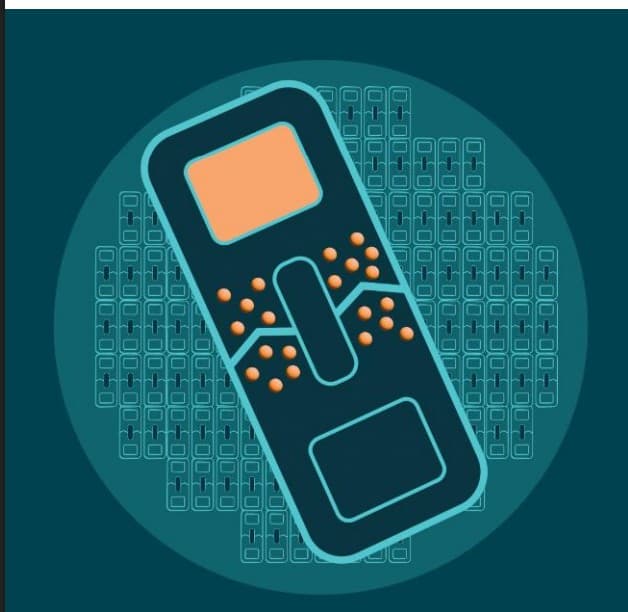
The architecture evolved from a single 2-channel flow path to a 206-channel parallelized array, demanding precise control of hydraulic resistance and manifold geometry.
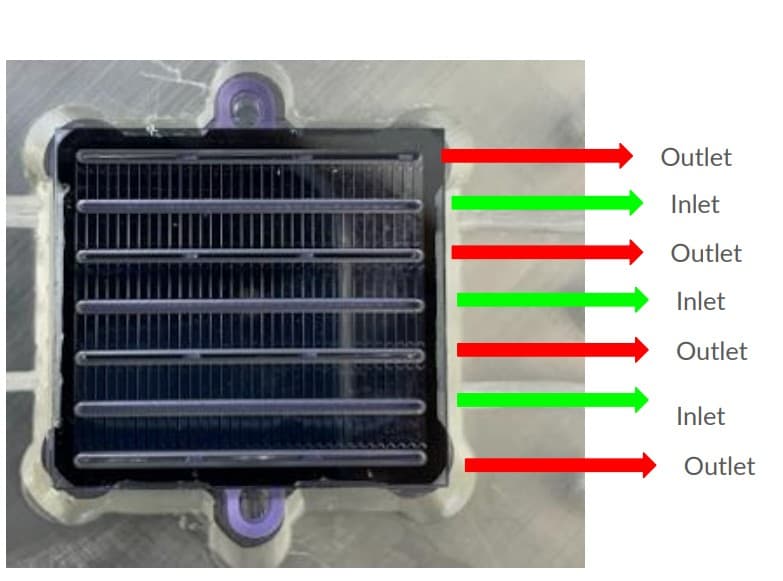
High Volume Microfluidic Chip, Fluid Flow Path
High-Volume Consumable Chip
The high-volume chip includes 206 interconnected through-holes that serve as vertical inlets and outlets for fluid flow. The size of the chip was limited by photolithography constraints, since increasing the active area caused the features to drift and lose accuracy. Because of this, scaling the system required a vertical stacking approach that spreads flow across several silicon layers instead of enlarging a single chip.
This stacked design created strict requirements for the gasket system. Each gasket had to provide a reliable seal between layers while also directing fluid through a controlled sequence of vertical and horizontal pathways. The final architecture met these needs by pairing high-density through-hole structures with a multilayer gasket design that preserved alignment, maintained uniform flow distribution, and kept the entire stack mechanically stable.
High-Volume Consumable Architecture
Component Breakdown
The consumable uses a modular polycarbonate housing that integrates the pressure, fill, and pneumatic interfaces. Upstream, an inlet reservoir with a built-in diffuser stabilizes incoming flow and ensures the chip stack receives uniform hydraulic loading across the full processing volume.
At the center, a stack of silicon microfluidic chips is sealed with custom injection-molded gaskets and constrained with precision spacers to maintain consistent channel geometry and sealing pressure.
Downstream, a shaped outlet reservoir with a flow-sensor port manages effluent and reduces dead volume to improve run-to-run measurement stability.
Prototyping & Validation
Prototyping involved an extensive cycle of SLA/FDM 3D-printed components for rapid fit, tolerance, and flow testing. However, surface absorption and biocompatibility issues with printed materials ultimately drove a transition to machined polycarbonate for validation units.
I designed a multi-port diagnostic pressure fixture to isolate failures across manifold interfaces, gasket ridges, and chip-to-chip joints, enabling systematic leak debugging across the vertical stack.
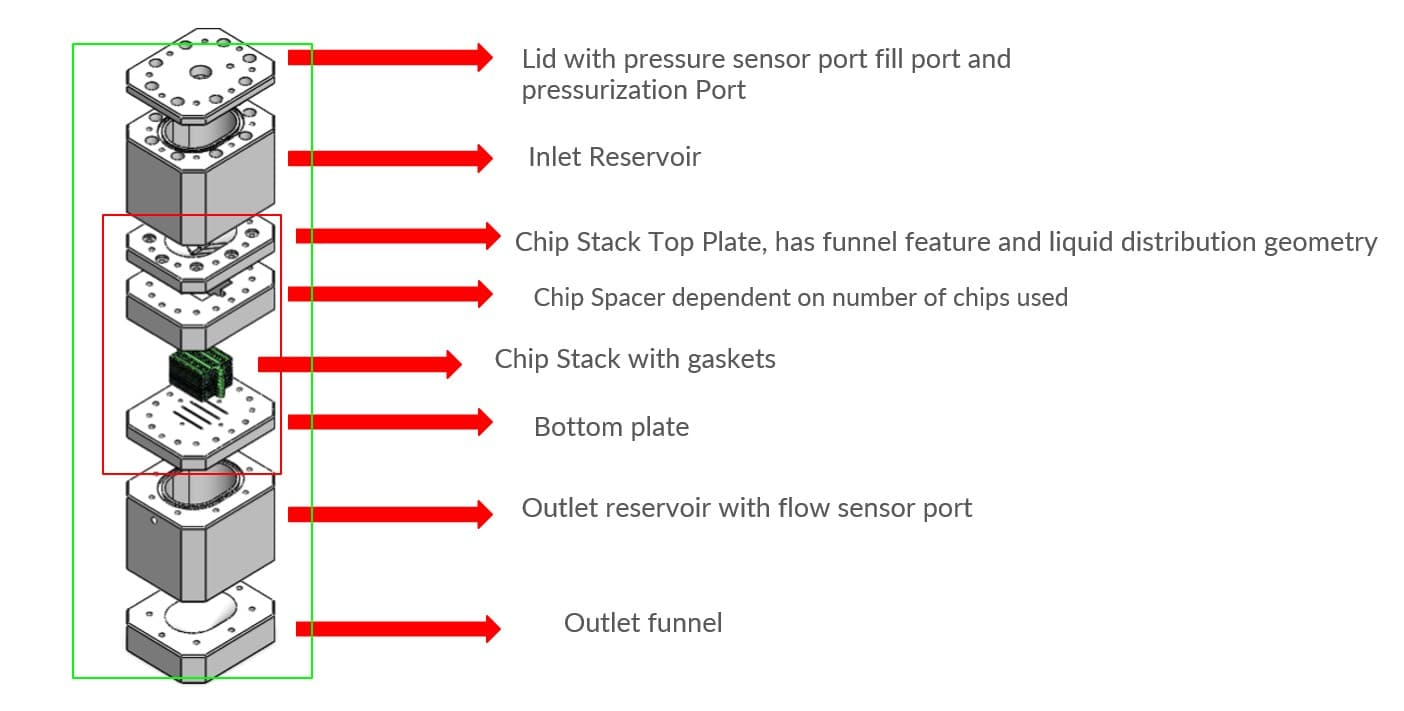
High-Volume Consumable Architecture
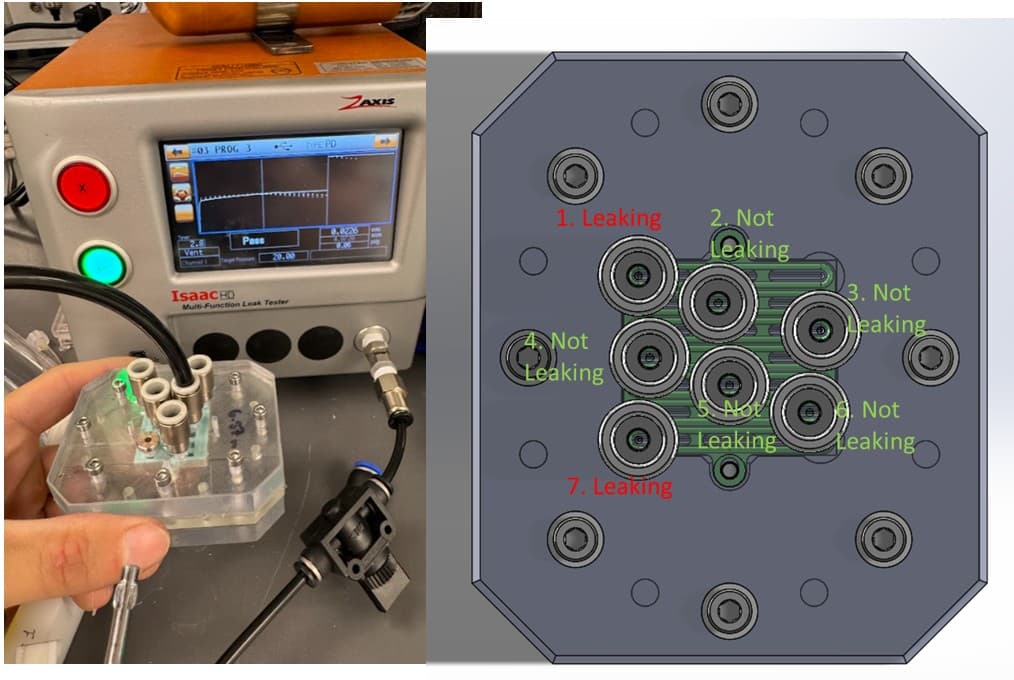
Custom pressure-diagnostic fixture with a push-to-connect manifold
The Fracture & Leakage Mechanics Problem
The silicon microfluidic chips were fabricated using DRIE, which produces very high-aspect-ratio channels but also creates a brittle substrate with low fracture toughness. When multiple chips were stacked, the assembly became highly sensitive to uneven clamping, torsion, surface flatness variation, and bending forces from the gasket. Any of these factors could cause cracking.
This created a very tight mechanical window. Too little compression resulted in leakage and too much compression caused chip fracture. The usable range between these two failure modes was only a few percent of total gasket deflection, which is much smaller than what standard sealing methods can reliably control.
To understand this relationship, I built a custom diagnostic fixture that measured sealing force against both leakage and breakage. The push-to-connect manifold allowed rapid and repeatable testing across a wide range of loading conditions and made it possible to characterize how sealing pressure interacted with chip stress.
Solution
Preventing substrate failure required rethinking both structural reinforcement and how the sealing force was applied. The final design introduced reinforced silicon bridge structures and a 3D gasket geometry that concentrated compression only around the fluid paths. This configuration preserved the required sealing pressure while significantly reducing the mechanical load transmitted into the chips. By isolating the chips from bending and torsional forces and lowering the net substrate stress, the multi-chip assembly became far more robust and reliable.
Innovation: 3D Gasket Topology
I developed a 3D microstructured gasket featuring raised sealing ridges that localize compression forces only around fluid paths. This dramatically reduces total contact area - and therefore total required clamp force - while enabling the gasket to conform to micron-scale surface variations.
Technical advantages:
- Minimizes bending forces transmitted to silicon
- Maintains seal integrity under high differential pressures
- Compensates for micro-scale surface unevenness and manufacturing tolerances
- Optimized Pressure-to-Force Ratio: By reducing the contact area, we achieved high localized sealing pressure (psi) with significantly lower global clamping force (lbf), effectively decoupling the sealing requirement from the fracture risk.
I utilized FEA (Finite Element Analysis) to iterate on the fine features of the gasket geometry, optimizing the ridge profile and bridge structures to ensure uniform compression and prevent blowout without creating stress risers.
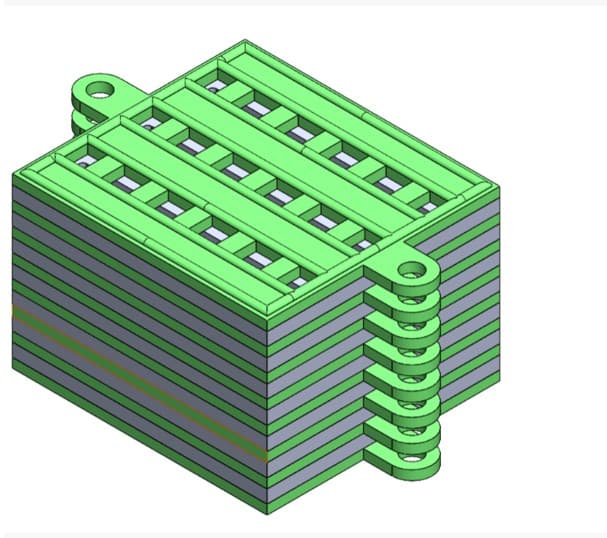
3D gasket ridges concentrating sealing force only where needed.
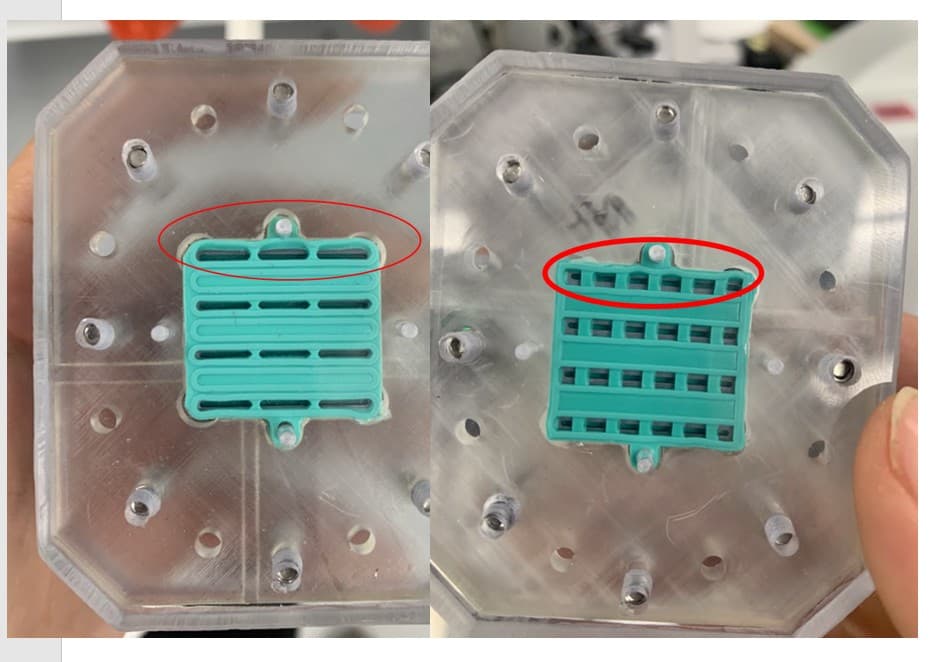
Reinforced gasket geometry with locator holes and thicker ridges.
Optimizing the 3D Gasket Geometry
Early iterations of the 3D gasket experienced ridge "blowout" under high pressure. Through iterative topology refinement, I resolved these issues by:
- Increasing ridge thickness to improve flexural rigidity
- Adding structural bridges for lateral reinforcement
- Reducing corner fillet radii to 0.4 mm to eliminate stress risers
- Relocating locator holes horizontally to provide material backing during pressurization
These changes produced a gasket capable of sustaining the required operational pressure envelope.
Validation Data: Sealing Performance
I performed a broad set of material characterization tests to determine a safe and reliable sealing window. This included evaluating different silicone rubber formulations and comparing Shore 60A and Shore 70A materials across a range of compression levels. Through this testing, I identified that Shore 70A at approximately 19 percent compression provided reliable sealing without causing chip fracture.
After defining these material and compression targets, I worked closely with an external injection molding vendor to refine the gasket design for manufacturability. I adjusted the geometry with their tooling engineers to ensure that the complex ridge features could be molded consistently at production scale while preserving the required sealing performance.
| Stack Config | Nominal Gasket Dimension | Nominal Chip Thickness | Nominal Spacer Size | Actual Spacer Size | Actual Compression % | Shore 60A Results | Shore 70A Results |
|---|---|---|---|---|---|---|---|
| 1 Stack | 1.75 mm (2 Gaskets) | 1.39 mm (1 Chip) | 4.05 mm | [4.00, 4.05] | [19.9%, 18.4%] | Similar to 70A | 0.020 psi leakage |
| 2 Stack | 1.75 mm (3 Gaskets) | 1.39 mm (2 Chip) | 6.70 mm | [6.67, 6.73] | [20.0%, 19.4%] | 0.0226 psi leakage | 0.0284 psi leakage |
| 3 Stack | 1.75 mm (4 Gaskets) | 1.39 mm (3 Chip) | 9.45 mm | [9.45, 9.50] | [19.0%, 18.25%] | 0.1106 psi leakage | 0.0677 psi leakage |
| 4 Stack | 1.75 mm (5 Gaskets) | 1.39 mm (4 Chip) | 12.16 mm | [12.24, 12.30] | [19.5%, 19.0%] | 2.382 psi leakage | 0.0390 psi leakage |
Final Production Architecture
The final production solution used a three-part injection-molded gasket set (Top, Middle, Bottom) that reliably sealed a five-chip silicon stack without mechanical failure. This architecture provided stable compression, predictable flow distribution, and strong manufacturability at scale.
I validated the final geometry using COMSOL multiphysics simulations. This included analyzing inlet-to-outlet pressure drop, lateral uniformity across the 206 channels, and overall flow symmetry through the stack.
The simulation results confirmed that the scaled architecture maintained the precise flow and shear conditions required for effective mechanoporation. I then verified this performance in live cell processing trials, which demonstrated that the high-volume system achieved biological outcomes comparable to the legacy low-throughput benchmark.
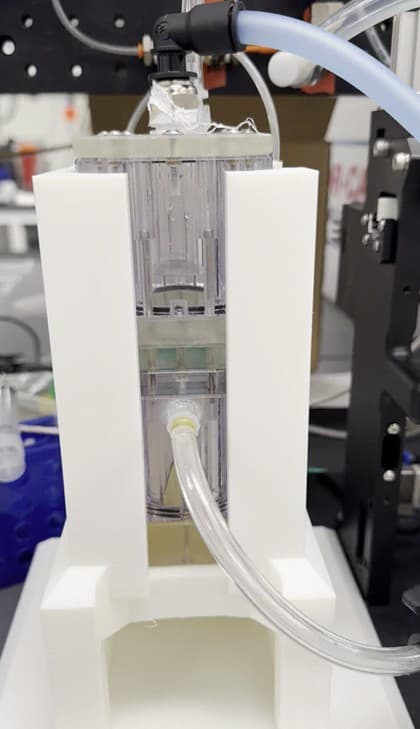
Assembled consumable for high-volume biological test
Engineering Artifacts Gallery
Scaling Concept
High-Volume Chip Stack
Validation Data
Failure Modes
3D Gasket Design
Optimized Geometry
Final Production